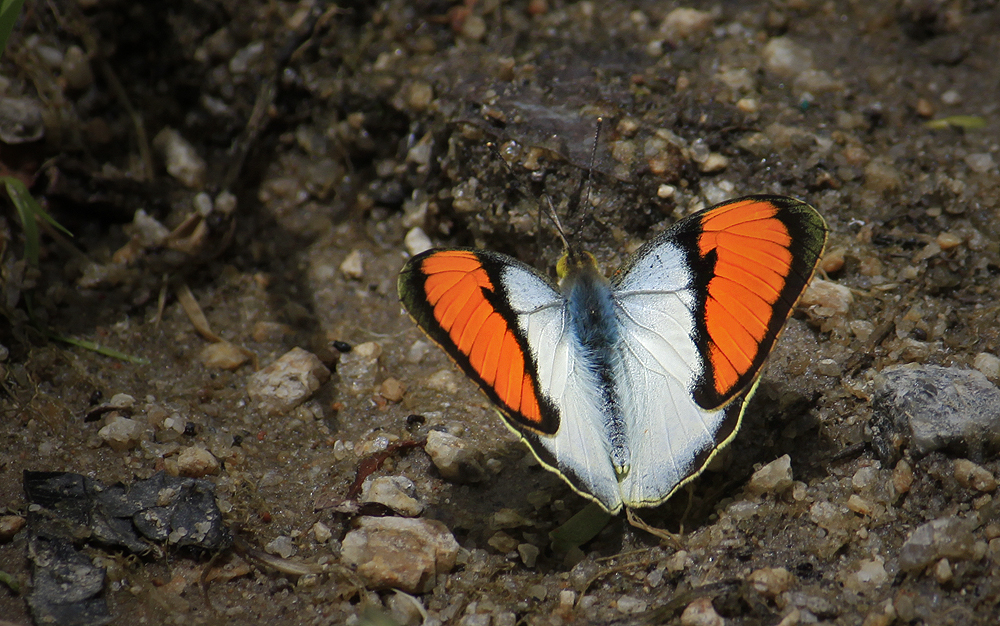
This trip was an epic journey filled with joy, and it was a
childhood dream come true for many reasons. I never thought that I would be
going to the Andamans this early in life. Honestly enough, the Andamans were
unreachable fruit until a year ago. I used to gaze at the image of the Andaman
Mormon from Isaac Kehimkar's book, and used to think "Ah, I wonder when
I'll get to see this butterfly! Probably not for a couple of years for
sure! Better just forget about it..."
But then I was surprised to find myself planning
a trip to the Andamans this year, with my then fiancé
Shreenidhi, who is now my husband. So I can rightfully say that the adventure
with him, which began with the Loris watching at IISc continues into a lifetime
story of wildlife tales!
We started our research for this trip many
months before the trip happened. The dates chosen were April 22nd to May 6th.
We booked our stays well ahead of time, and we were glad to have opted for air
conditioned accommodation in all the places. The humidity at 98%, would have
been too oppressive for us otherwise.
Our flight to Port Blair was from Chennai, and
we traveled from Bangalore to Chennai by road. It was a pleasant 2 hour
flight, and I still can't forget the moment we got down from the plane at Veer
Sawarkar Airport. The weather was hot and humid, and was a drastic change from
the conditions maintained inside the aircraft.
With ears blocked due to the flight, we started
off to Wandoor. On the way, we saw a lot of ruined houses and backwaters. Our
cab driver Mr. Ravi told us that the region was used for agriculture once upon
a time. But due to the catastrophic tsunami of 2004, the ocean reclaimed it's
territory.
In one of these lakes/ backwaters, we saw an
endemic water bird called the Sunda Teal. It was our first endemic, and we were
excited about a great start.
We reached ANET at around 8am. Andaman and
Nicobar Environment Team (ANET) is an organisation based in Wandoor, about 40km
from Port Blair, which conducts nature walks for tourists and is a base for many
wildlife researchers. ANET is also associated with a diving group called
Lacadives, which offers scuba diving courses of different levels.
 |
| Sunda Teal |
We stayed at ANET for three nights. We saw many
beautiful species of birds and butterflies right on campus. Some birds we saw were
the Brown Shrike (ssp lucionensis), Orange Headed Thrush, Brown Coucal, Eastern
Jungle Crow etc., Amidst the butterflies, the Painted Jezebel caught my
attention on the very first day. We also saw Andaman Viscount, Andaman Clipper
and Andaman Yamfly in our three days there. One one of the three days, we made a
day trip to the nearby Chidiya Tapu. It was a beautiful place, and we got to
see the very beautiful Collared Kingfisher here for the first time. Chidiya
tapu has a lovely beach called the Munda Pahad beach, and further from this
beach is the trek up to Munda Pahad, where a beautiful lighthouse is situated.
But unfortunately, our trip seemed ill planned because we reached the beach at
5pm and the last bus back to Port Blair was at 6pm, which we were unaware of.
We saw only one squirrel throughout our trip, and this was at the Munda Pahad Beach. To our surprise, it was a Five Striped Palm Squirrel and not three!

There is a magnificent mangrove beach a stone's
throw from ANET, and it was quite an experience walking in the mangroves when
there was low tide. Fiddler Crabs, Mud Crabs, Mudskippers, Snails and Frogs were
all over the place. The silt of these mangroves is just heavenly to step on!


The same day, we visited a beach on the other
side of ANET, to find Sea Kraits. It was about 9pm when we spotted our first,
the Yellow Lipped Sea Krait. Not long before we spotted the other species found
in the same place, called the Blue Lipped Sea Krait. These snakes were so
beautiful that we did not feel like leaving the beach and heading back to base.
We saw only one squirrel throughout our trip, and this was at the Munda Pahad Beach. To our surprise, it was a Five Striped Palm Squirrel and not three!
 |
| Indian Painted Jezebel |
 |
| Andaman Viscount |
 |
| Andaman Yamfly |
 |
| Andaman Yamfly |
 |
| Andaman Viscount |
 |
| Mud Crab |
 |
| Mud Crab |
 |
| Fiddler Crabs |
 |
| Blue Lipped Sea Krait |
 |
| The fin like tail of the beautiful Blue-lipped Sea Krait |
 |
| Yellow Lipped Sea Krait |
 |
| Shreenidhi with his diving gear, just into the sea! |
Havelock is surprisingly small considering it is
the tourist hotspot. There are just two beaches: Kaala Pattar and Radhanagar.
Here, we rented a two wheeler, the Bajaj Avenger. Havelock is known to be the
'Goa' of the Andamans, and wildlife enthusiasts like me probably don't expect a
lot of birds and butterflies. But to our pleasant surprise, the forests here
are just as filled with life as the ones in Wandoor. It was here, that we saw
one of the most important butterflies on our wish list: The Bengal Leopard
Lacewing, for the first time. It is a beach loving butterfly, active majorly
between the late morning and early afternoon. It fluttered past us at a height
of about 10 metres from the ground, and enchanted us with it's lovely graceful
sailing.
At Radhanagar, the forest cover is not very
dense, but the trees are very tall and they rise from right next to the beach,
which makes them uniquely beautiful. We saw a Water Monitor Lizard here. It was
large and monstrous, and seemed quite obliged to strike poses for us. We walked
along the forest tracks near the beach to find the Andaman Saronis Sunbeam and
Southern Birdwing butterflies. We also saw a lot of Yamflys, and we came across
a single Andaman Centaur Oakblue butterfly. We said to ourselves, "Let's
come here again tomorrow!"
But then,we changed plans and headed to Kaala
Pattar instead, and we didn't regret the choice at all.We were so glad we
didn't spend another day at Radhanagar because this beach was so much richer.
Andaman Lesser Gull was a new butterfly for us at Kaala. We saw Olive Backed
Sunbird, Small Minivet, Red Breasted Parakeet, Long Tailed Parakeet, and the
most delightful Asian Fairy Bluebird. We also saw the Vernal Hanging Parrot. We
heard a metallic mimicking call which sounded like that of a Bulbul. As we
looked around and traced the call, we found the very talented Andaman Drongo!
There were Tiny Grass Blue butterflies everywhere. On our way back from Kaala,
we stopped by at a tree where we found the endemic Andaman Green Bronzeback
Treesnake! It was a feast to the eyes!
 |
| Water Monitor Lizard |
 |
| Andaman Centaur Oakblue |
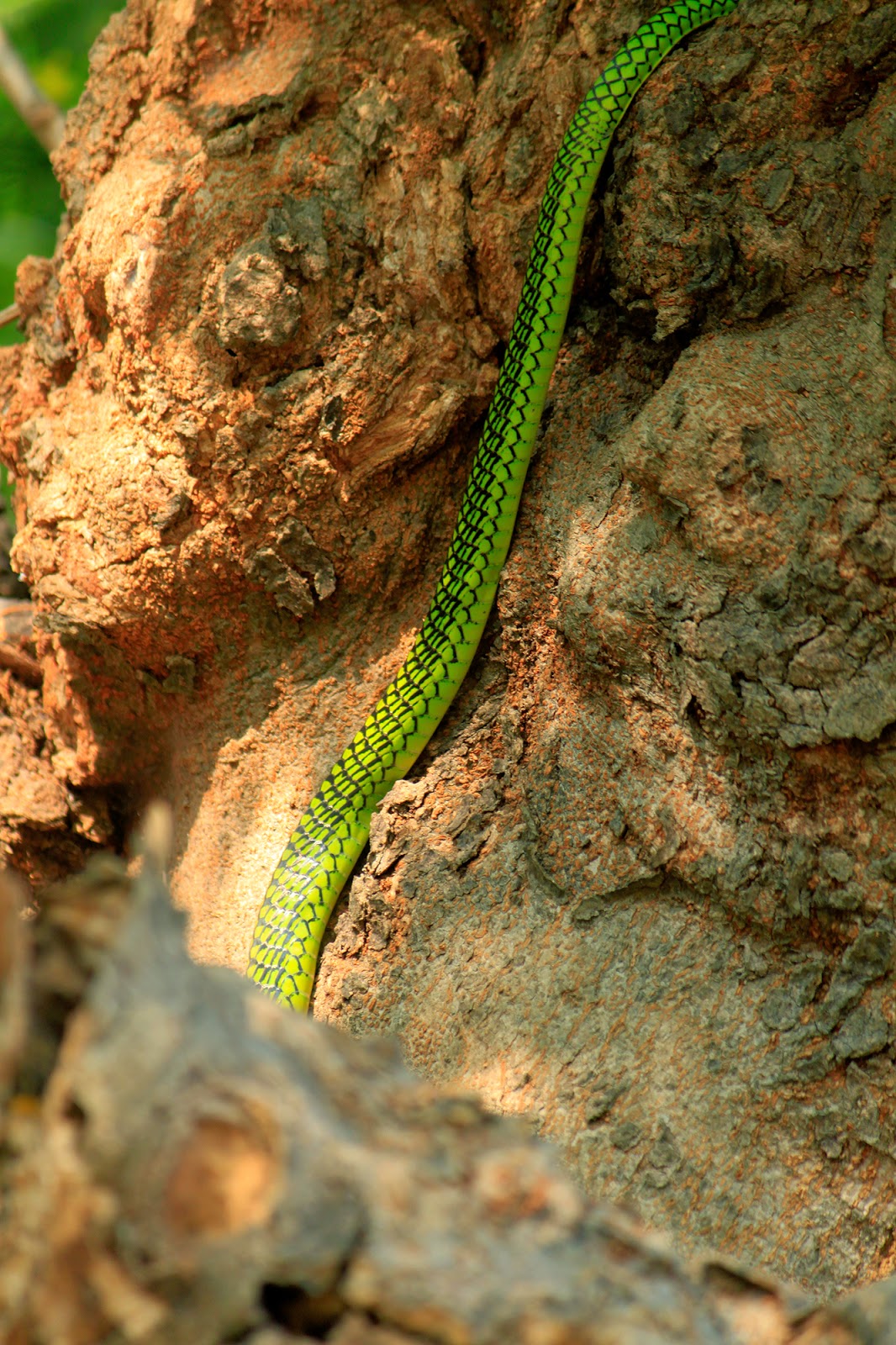 |
| Andaman Green Bronzeback Treesnake |
 |
| Andaman Green Bronzeback Treesnake |
 |
| Andaman Green Bronzeback Treesnake |
Though we wanted to explore Neil Island, we couldn't as the Coastal Cruise does only one to-and-fro trip per day. The return to Havelock was early in the afternoon, so Neil is not a possible day trip from Havelock.
We were told by many that 'Full Moon Cafe' is the
best in Havelock, but we begged to differ. Full Moon Cafe served us bland food,
and I can never forget the soggy Masala Pappad. Instead, a little further is
Anju Coco Cafe, which served us the tastiest food on our entire trip. Indian,
Chinese or Continental, this restaurant made sure we left with our hearts and
tummies both full.
After our four nights at Havelock, we took the
took the seaplane to Port Blair from the jetty. This was the experience which
blew our minds to no ends. The beauty of the coastlines cannot be better
experienced than from a seaplane. The ride on the Cesna aircraft costed us about
four thousand per head. We found so much excitement in it that we couldn't have
asked for better.


 |
| Banana Nutella Pancake at Anju Coco Cafe - Stuff to die for! |
Upon reaching Port Blair, we took the Andaman
Trunk Road to North Andaman. This was a bumpy cab ride, but it was very
memorable. There are steamers connecting the small islands to one another, and
these steamers carry about 2 buses and a small number of cars at one time. One
steamer crossing is at Middle Strait, and the other one at Mayabunder, just
before the convoy into the Jarawa Reserve Area.
The Jarawa Reserve Area is a protected area
reserved especially for the Jarawa Tribe, who are one of the five kinds of
tribes across Andamans. They have been known to be hostile, and reluctant to be
contacted by the rest of the world. Hence, measures have been taken to respect
their privacy. Any vehicle that has to pass through this reserve has to enter
the convoy at one of the three particular times: 9:30am, 12:30pm and 2:30pm. No
overtaking,no stopping and no photography is allowed inside the reserve. A
police officer always leads the convoy.
The journey through the reserve is about 40km,
and due to the speed restriction, it takes about 2 hours to get through. These
jungles are absolutely undisturbed by tourism and untouched by civilization, and
hence are so pristine that you tend to agree with the Jarawas. Why would anyone
wish to be contacted by the rest of the world when you are home in a place as
beautiful as this? It was on this road that we got to see yet another very
important butterfly on our wish list, the Andaman Tree Nymph. It was
unfortunate that we couldn't stop to take a look at it, but we felt fortunate
to have seen it at least. We reached Diglipur after a total of 9 hours of
travelling. We checked into Pristine Beach Resort at 8pm.
 |
| Instructions on the sign-in sheet before the convoy. |
The next morning we were greeted with the lovely
sight of the Bengal Leopard Lacewing very close to us. It also sat on our feet
and we enjoyed the butterfly's company for quite a long time. There were quite
a good number of Andaman Clipper butterflies in the vicinity of our room. Our
accommodation was a fair distance from the town of Diglipur, and the areas in
and around the property of the resort were amazing for birds and butterflies.
We saw endemics like the Andaman Spotted Woodpecker, Andaman Woodpecker,
Andaman Flowerpecker etc.,
Kalipur beach, a 5 minute walk from the resort,
is a nesting site for two species of turtles: The Green Sea Turtle and the
Olive Ridley Sea Turtle. Though we were too late for the laying as well as the
hatching season, we were lucky to see a newborn Green Sea Turtle on one of the
nights of our stay.
Ramnagar, a settlement about 40km from the
resort, is home to one of the most beautiful cave systems in the Andamans, the
Alfred Caves. It is a very difficult trek from Ramnagar, and I had almost given
up halfway through. Peak of summer was a tough time for a hard trek. But what
was at the end of the journey made us forget all the sweat and pain it took to
get there. The smell of bat guano, the sight of thousands of bats and nests of
Indian Edible Nest Swiftlets. These caves, though open to tourists, are highly
protected and guarded by forest officials who take their job very seriously.
 |
| Bengal Leopard Lacewing |
 |
| Bengal Leopard Lacewing |
 |
| Bengal Leopard Lacewing |
 |
| Hatchling of Green Sea Turtle |
 |
| Indian Edible Nest Swiftlets in their nests |
 |
| Perhaps, a mother and father on a nest |
There were two kinds of beautiful bats in the cave we got down into: Anderson's Leaf Nosed Bat and Dobson's Horshoe Bat.
 |
| Dobson's Horseshoe Bat |
 |
| Anderson's Leaf Nosed Bats |
 |
| Anderson's Leaf Nosed Bats |
 |
| Anderson's Leaf Nosed Bat |
 |
| Swiftlet nests on the side walls of the cave |
 |
| Thousands of bats in the depths of the cave! |
The trek to the caves and back was very fruitful too! We crossed a trench created by a seasonal stream, and the number of butterfly species we recorded here was unbelievable. Seargents, Sailers, Pierrots, Ceruleans - of unknown kinds. It was paradise for a butterfly enthusiast.
 |
| Andaman Common Lascar on Shreenidhi's shoe |
 |
| Sullied Sailer (Identity doubtful, hence not included in the species list below) |
 |
| Indo-Chinese Elbowed Pierrot |
 |
| Neptis species |
 |
| Andaman Saronis Sunbeam |
 |
| Andaman Common Tit |
 |
| Andaman Lesser Gull |
 |
| Andaman Clipper |
 |
| Andaman Yellow Orange Tip |
Alive came my big dream.
The Andaman Mormon flew past me gracefully as my
heart pounded with joy!
I turned as he disappeared, only to see an
Andaman Treepie!
I was out of words for quite a while. I didn't
have to try too hard to convince myself that I wasn't dreaming, because the
sun's heat seemed too excruciatingly real. We were famished by the time we returned,
and were paralyzed with sore limbs for the last two days of our stay at
Diglipur.
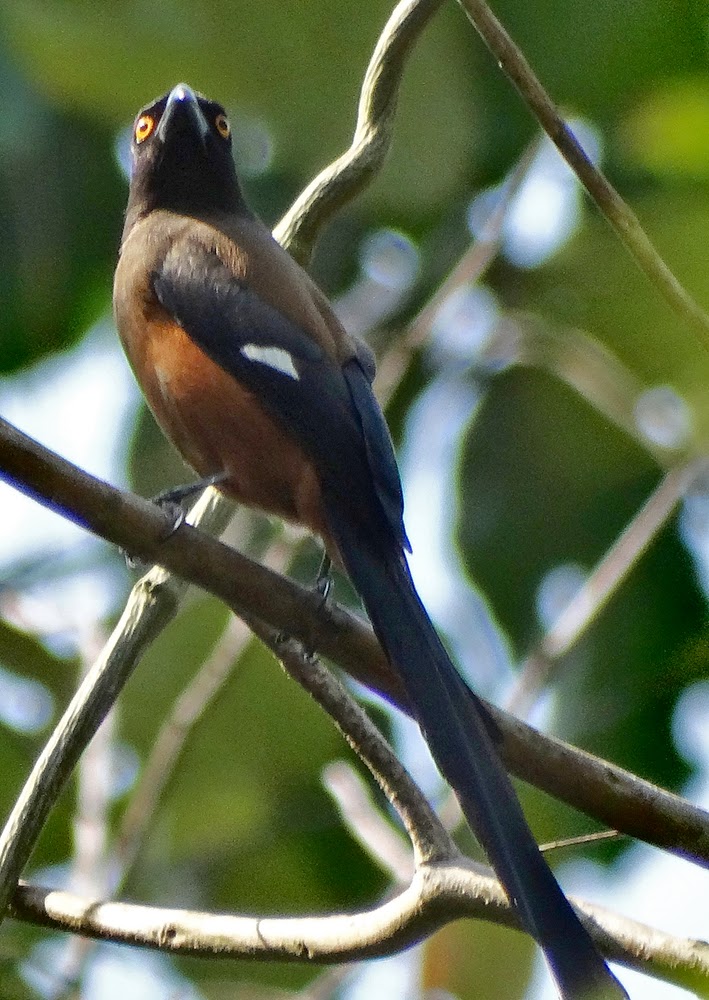 |
| Andaman Treepie |
Ross and Smith Islands are a treat to the eyes,
jellyfish swimming everywhere close to us while in the water. We also visited
Craegy Island, where we saw a pair of Beach Thick Knees.
When we returned to the resort, we were
delighted by the sight of the endemic Emerald Gecko, which we saw inside the
roof of the restaurant.
 |
| Beach Thick Knee (Beach Stone Curlew) |


North Andamans added a lot of species to our
list, and we had seen everything on our wishlist by the time we were done at
Diglipur. We headed back to Port Blair in the same cab which got us to
Diglipur.
The marine aquarium is a must visit for sea life
enthusiasts.
Our flight from Port Blair was supposed to leave
at 7am, but due to bad weather, it was pushed to 12:30pm. This was
disappointing, but apparently it is a very common phenomenon in the islands.
Weather always remains unpredictable no matter how much is forecast.
The takeoff from Port Blair was almost
depressing, but the beautiful aerial view of the islands distracted me from the
sad fact that we were leaving the Andamans. As I enjoyed my last glimpse of the
islands, a drop of tear prepared to jump off each of my eyes. Just before they
fell, the crack in my ear diverted my attention,and I frantically looked for
chewing gum in my pockets. The next view through my window, and we were above
the clouds.I closed my eyes, leaned my back on the reclining seat, and visualized all the beautiful birds and butterflies we saw on this amazing trip.
Then, I opened my eyes and smiled to myself - "Wow, I'm on top of the
clouds in every sense of the phrase!"
1. Clam
2. Greenish sea cucumber
3. Graeffe's sea cucumber
4. Black diadem sea urchin
5. Blue sea star
6. Masked Puffer fish
7. Trigger fish
8. Squirrel fish
9. Moorish Idol
10. Lined surgeonfish
11. Tomato anemonefish
12. Clark's anemonefish
13. Marley's butterflyfish
14. Yellowback fusilier
15. Neon fusilier
16. Lizardfish
List of endemic species seen throughout the trip:
Birds
1. Sunda Teal (Anas
gibberifrons)
This bird is strikingly different from other teals due to
it's white eye-patch. We found them in a group of around 20 individuals, in one
of the small backwaters of Sippighat, on the way from Port Blair to Wandoor.
They were accompanied by Lesser Whistling Ducks, Common Moorhen, Purple Moorhen
and Little Grebe.
2. Black Naped Oriole (Oriolus
chinensis)
We spotted this beauty at ANET, at around 9am. This Oriole
is a resident of the Andamans and winter visitor to Bangladesh and certain
parts of India. Cannot be fully classified as endemic.
3. Brown Shrike (Lanius
cristatus lucionensis)
This bird is probably the most common bird inthe Andamans.
4. Asian Glossy Starling (Aplonis panayensis tyleri)
A beautiful black bird with a green sheen. Very common in
South Andaman, but slightly less common in the north. Resident species of
Andamans which visits northeast India.
5. White Headed Starling (Sturnia erythropygia)
Another common bird, slightly more common in the South.
6. Greater Racket Tailed Drongo (Dicrurus paradiseus ceylonicus)
Looks very much like the Lesser Racket Tailed Drongo, but is
a subspecies of the Greater.
7. Andaman Drongo (Dicrurus
andamanensis)
Larger and longer than Black Drongo, tail is broader.
8. Eastern Jungle Crow (Corvus
levaillantii)
9. Pacific Swallow (Hirundo
tahitica)
Large number of them seen in the jetty at Havelock.
10. Pacific Reef Egret (Egretta
sacra)
Seen on rocky side of Kalipur beach.
11. Brown Coucal (Centropus
andamanensis)
The only coucal in the Andamans. Common throughout.
12. Andaman Serpent Eagle (Spilornis elgini)
Smaller than Crested Serpent Eagle and looks much darker in
flight.
13. Andaman Treepie (Dendrocitta
bayleii)
 |
| Andaman Serpent Eagle |
Sounds very much like an Oriole and confuses the
listener. We saw this beauty at Ramnagar, on the way to Alfred Caves.
14. Andaman Woodpecker (Dryocopus hodgei)
Looks similar to Great Black Woodpecker, but is
much smaller without a white belly.
15. Spot Breasted Woodpecker (Dendrocopos analis)
We saw them in the north as well as south,
almost always in pairs. The most beautiful woodpecker of the Andamans!
16. Andaman Green Pigeon (Treron chloropterus)
The only green pigeon in the Andamans.
17. Olive Backed Sunbird (Cinnyris jugularis)
Found commonly throughout, females more common
than males.

 |
| Olive Backed Sunbird female |
18. Beach Thick Knee (Esacus neglectus)
A very large sized Thick Knee/ Stone Curlew.
Craegy Island is where we saw a pair of these.
19. Glossy Swiftlet (Collocalia esculenta)
Tail is squarish in shape and has a distinct
white belly. Swoops close to the ground while flying.
20. Andaman Bulbul (Pyconotus fuscoflavescens)
We saw this lovely bulbul a few times in South
Andamans, more so in Wandoor. But none in the North.
21. Edible Nest Swiftlet (Collocalia fuciphaga)
Nests in Alfred Caves, Ramnagar. Beautiful cup
shaped nests are made of their own saliva.
22. White Breasted Woodswallow (Artamus leucoryncbus)
The only woodswallow of Andamans. We saw this on
the way from Diglipur to Ramnagar.
Butterflies
1. Andaman Saronis Sunbeam (Curetis saronis saronis)
At Havelock and also at Ramnagar.
2. Indo-Chinese Elbowed Pierrot (Caleta elna noliteia)
Ramnagar
3. Andaman Centaur Oakblue (Arhopala centaurus coruscans)
Havelock, Ramnagarand Diglipur
4. Andaman Yamfly (Loxura atymnus prabha)
Found throughout the Andamans. Very common.
5. Andaman Dark Wanderer (Pareronia ceylanica naraka)
Seen in plenty at Ramnagar, but also seen at
Radhanagar beach, Havelock.
6. Oriental Great Orange Tip (Hebomoia glaucippe glaucippe)
Also found in Northeastern India. We saw these
in abundance mostly within the Jarawa reserve.
7. Andaman Lesser Gull (Cepora nadina andamana)
We saw them in larger numbers at Kaala Pattar, Havelock.
We also saw them at Ramnagar.
8. Andaman Common Gull (Cepora nerissa lichenosa)
 |
| Andaman Lesser Gull |
Only one seen, at Alfred Caves.
9. Indian Painted Jezebel (Delias hyparete indica)
|
| Andaman Common Gull |
We saw them only in South Andaman. This species
is also seen in Northeastern India.
10. Andaman Yellow Orange Tip (Ixias pyrene andamana)
Seen more often from Middle Andaman towards
North. Photographed one at Ramnagar.
11. Andaman Mormon (Papilio mayo)
Beautiful and slow flight just as the Blue
Mormon. Saw this species thrice at Ramnagar.
12. Andaman Palmfly (Elymnias cottonis)
Common throughout the Andamans.
13. Andaman Clipper (Parthenos sylvia roepstorfii)
Abundant in the north, relatively less common in
the south.
14. Andaman Baron (Euthalia acontius)
Photographed once at Diglipur.
 |
| Andaman Baron |
15. Andaman Viscount (Tanaecia cibaritis)
Seen at Wandoor as well as Ramnagar.
16. Bengal Leopard Lacewing (Cethosia cyane cyane)
We saw the species three times while in the
North Andaman, and only once (at Havelock) while in the South.
17. Andaman Common Pierrot (Castalius rosimon alarbus)
Seen at Havelock as well as Diglipur.
18. Andaman Tree Nymph (Idea agamarschana cadelli )
 |
| Andaman Common Pierrot |
We saw four individuals in all while travelling
through the Jarawa reserve area.
Subspecies cadelli
is that of the species Myanmar Tree Nymph.
19. Andaman Common Tit (Hypolycaena erylus andamana)
We saw only one, at the forest guard camp just
before Alfred Caves.
20. Andaman Silver Forget-me-not (Catochrysops panormus andamanica)
We saw one individual in Diglipur, and captured
a record shot.
21. Andaman Common Lascar (Pantoporia hordonia cnacalis)
 |
| Andaman Silver Forget Me Not |
Very different from the mainland subspecies due
to the absence of the third horizontal yellow band. We saw two individuals of
this species at Ramnagar.
22. Khasi Golden Birdwing (Triodes aeacus aeacus)
A species also found in Northeastern India. We
also saw the Southern Birdwing (Triodes
minos) in the same places. Wandoor, Havelock and Diglipur. The two species
fly indistinctly different patterns. Also, the Golden seemed more manouverable
and fast when compared to the slowness of the Southern. Shapewise, when in
flight,the Golden forms a more acute trapezium when the four wingtips are
joined by imaginary straight lines.
23. South Andaman Crow (Euploea andamanensis andamanensis)
We saw this only in Wandoor and Havelock, in
decent numbers. A fairly common butterfly locally.
List of underwater species identified: |
| South Andaman Crow |
 |
| South Andaman Crow |
1. Clam
2. Greenish sea cucumber
3. Graeffe's sea cucumber
4. Black diadem sea urchin
5. Blue sea star
6. Masked Puffer fish
7. Trigger fish
8. Squirrel fish
9. Moorish Idol
10. Lined surgeonfish
11. Tomato anemonefish
12. Clark's anemonefish
13. Marley's butterflyfish
14. Yellowback fusilier
15. Neon fusilier
16. Lizardfish
To all those who made this possible...
Shreenidhi, your companionship and care is beyond any kind of thanking, so I shall proceed to showing my gratitude to those others that were a part of this experience actively as well as passively.
My special thanks to these people who helped plan our trip: Rohit Chakravarty, Sowdamini S. Prasad and Kesava Murthy. Rohit Chakravarty for the identities of the bats found at Alfred Caves. Thanks to the Lacadives team for introducing us to the world of open waters: Nigel, Leone, Arnav, Shyam. Thanks to Joeclyn, Smitha, Cammy and Aditi of the ANET team. Also, thanks to Mr. Anand, owner of Pristine Beach Resorts, for organising our plans in the North Andamans. Our cab drivers, Mr. Ravi and Mr. Javed for their patience while we made them stop every time we saw a bird or a butterfly. The tour guides at Alfred Caves who helped me overcome my fears of getting into difficult caves! A huge thank you to my mother-in-law Mrs Manjula, for all her support and contribution for this trip. Last but not the least, I am enormously grateful to Kaustubh Thomare for lending his laptop to me, without which I would not be able to process the pictures or upload this blogpost!
My special thanks to these people who helped plan our trip: Rohit Chakravarty, Sowdamini S. Prasad and Kesava Murthy. Rohit Chakravarty for the identities of the bats found at Alfred Caves. Thanks to the Lacadives team for introducing us to the world of open waters: Nigel, Leone, Arnav, Shyam. Thanks to Joeclyn, Smitha, Cammy and Aditi of the ANET team. Also, thanks to Mr. Anand, owner of Pristine Beach Resorts, for organising our plans in the North Andamans. Our cab drivers, Mr. Ravi and Mr. Javed for their patience while we made them stop every time we saw a bird or a butterfly. The tour guides at Alfred Caves who helped me overcome my fears of getting into difficult caves! A huge thank you to my mother-in-law Mrs Manjula, for all her support and contribution for this trip. Last but not the least, I am enormously grateful to Kaustubh Thomare for lending his laptop to me, without which I would not be able to process the pictures or upload this blogpost!