Sunday, January 27, 2013

Life Cycle of Commander (Moduza procris)

This is quite an uncommon butterfly in Bangalore. Nevertheless, it can most definitely be seen in certain places during the post monsoon and winter seasons. Lalbagh and JP Nagar reserve forest are known to be Commander habitat. The larval host plants for this butterfly are: Neolamarckia cadamba, Cadaba fructiosa, Hedyotis orixense, Mitragyna parvifolia, Mussaenda frondosa, Ochreinauclea missionis, Wendlandia exserta, and W. thyrsoidea.
The caterpillar, in its last instar, found on 10th January 2013. It was feeding on Mussaenda frondosa. This plant has soft hairy leaves, and blooms pinkish red flowers. Grown as ornamental in most gardens.

A beautifully camouflaged caterpillar this is, chestnut coloured with brown and black blotches.


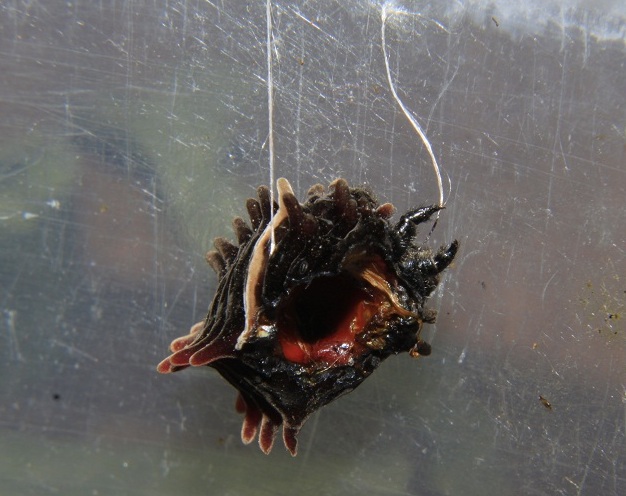
It wandered about the container endlessly for a day after it stopped consuming any leaves on 11th January. Instead of the usual dry and spherical excretions, it was semi solid and moist. It created webs everywhere it wandered.

It formed a cremaster on 12th January and pupated sometime during the night. This is the pre-pupa stage, after cremaster formation. Length of caterpillar in this stage: 31mm


The pupa measuring 23mm, on 13th January, 3:30pm:

Ventral side

Dorsal side
The pupa turned dark and transparent on 22nd January, and the adult emerged at 10:20am on 23rd January.  The pupa stage therefore lasted 11 days.
Emergence of the butterfly:


The adult emerges by pushing the pupal case with its proboscis.


The wings are intricately folded inside the pupa. They are wet and dripping with excess fluid. It is this fluid that imparts colours to the butterfly's wing scales.


After emerging, it is essential that the butterfly gets to hang down from something, so that gravity does its job of straightening out the veins before the wings dry. Sometimes, the wings might not dry in the right position, causing the butterfly to be unable to fly. The wings are partially stretched out and the butterfly is still wet here:


Wings have completely dried and the butterfly is taking its time before deciding to display its flashy red upper side..


 Few minutes after emerging, the layers of the proboscis are not yet aligned:


Behold, Moduza procris, the upper side. Wingspan of this individual, was 65mm.


A close up of the genitalia of this beautiful male:


The empty pupal case:


The beautiful underside of the adult male:


He was released in a good place which is known to have populations of his own kind, and it was an absolute joy watching his jerky flight as he disappeared into the thickets!

Thursday, January 17, 2013

Life Cycle of Common Jezebel (Delias eucharis)

The larva of the Common Jezebel feeds on Loranthus. This caterpillar was found in its last instar on 27th December 2012, thanks to GS Girish Kumar! There were five caterpillars in all, and they constructed a lot of webs and silken threads, for no apparent reason, inside the container in which they were raised. It was unlike most other caterpillars I have raised, because they web around only during the time of pupation.


It pupated on 3rd January 2013. Freshly formed pupa and the caterpillar's last moult:


Pupa, night before eclosion:


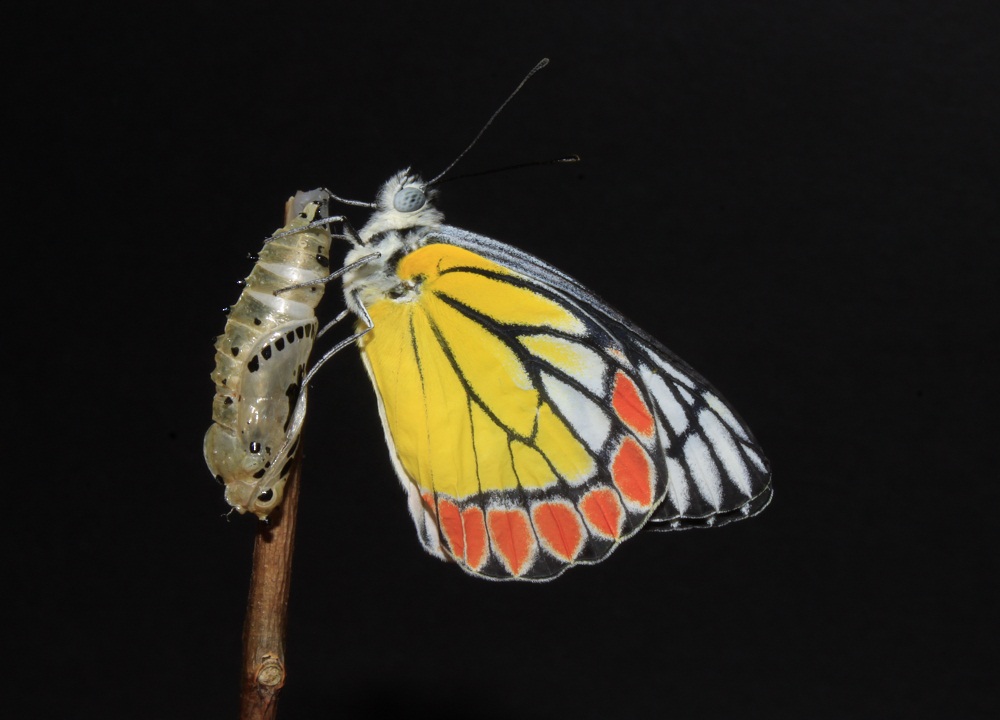
Adult male, after emergence:


Adult male, upper side:


Adult female, upper side:


Saturday, January 5, 2013

Life Cycle of Gaudy Baron (Euthalia lubentina)

Two caterpillars were found at Jalahalli last month, Nitin and I raised one each. They feed on Loranthus. Special thanks to Ashok Sengupta sir and Girish!

The caterpillars were in their initial instars when collected from the field. Image clicked on 4th December 2012:

Later, after two weeks, they had gained mass and length. Image by Nitin:


The pupa, few days after pupation:
Ventral view
Lateral view

 The adult butterfly, after eclosion. This individual turned out to be a female.


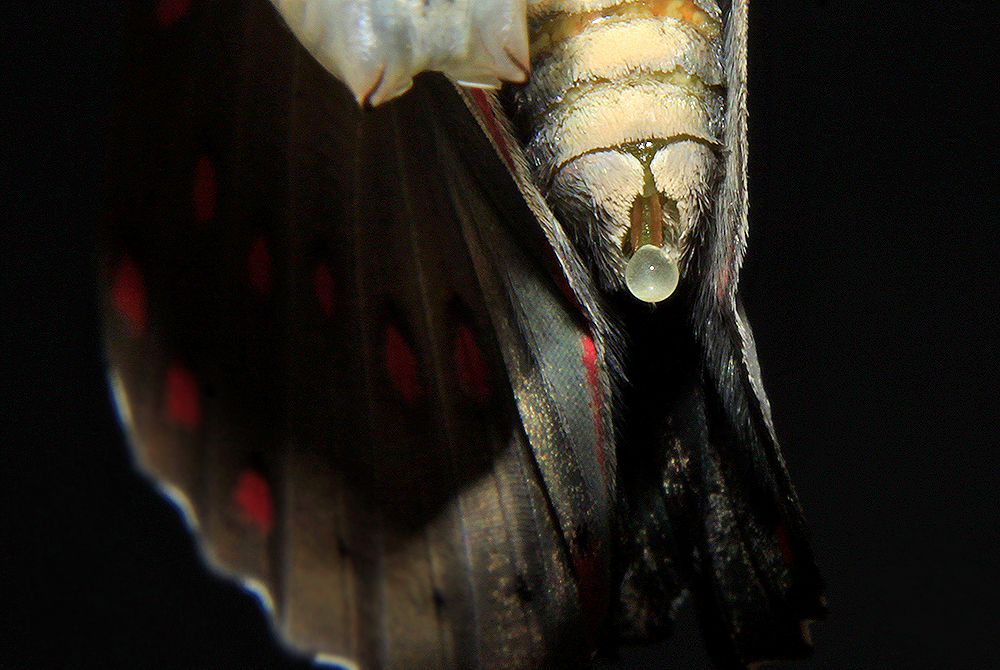
The butterfly is wet soon as it emerges. It takes a while to dry. Here are a few close ups of the butterfly while it was still in the process of drying up! Liquid dripping from the abdomen:


The vacant pupal case:


Time taken for the metamorphosis since it was found: 32 days
It was probably around 10 days old at the time it was found, and so we can round it off to 42 days, approximate length life cycle.

Happy butterflying!


Saturday, December 22, 2012

Life cycle of Peacock Royal (Tajuria cippus)

This individual was found on Loranthus at Jalahalli on 2nd December 2012. It was in its last instar. One of the most queer-looking caterpillars I've seen till date. Looks like bird droppings on a leaf. Could also camouflage itself on a stone or on the bark of any tree. I thank Ashok Sengupta sir for finding this beauty despite how well-hidden it was!


It pupated on 6th December 2012, at 8pm. Even though I missed watching the pupation, I could get a shot at the freshly pupated stage. At this point of time the colours are generally lighter/ paler:


The next day morning, after the pupa had hardened and the colours were darker. On December 10th, the wing patterns and veins became slightly noticable on the lateral side of the pupa:


Dorsal view of the pupa on December 10th:


On December 17th, 8:50am.


On 18th, sometime during the afternoon, the butterfly emerged:


This individual is a male. Flight pattern is fast and jerky, this beautiful brilliant blue is meant to deceive the predator. The predator looks for a blue butterfly where as the underside is white and it can easily hide away!

Wednesday, December 12, 2012

Life Cycle of Common Rose (Pachliopta aristolochiae)

This individual has been quite intriguing since day one, simply because a Crimson Rose (Atrophaneura hector) was seen hovering around the plant Aristolochia indica, when the egg was collected at Jalahalli. Two of us, Nitin R and myself, watched the Crimson Rose lay eggs on the plant and took two individuals to raise. But as this turned out to be a Common Rose, we assumed that it must have been laid by a Common Rose previously on the same plant, before the Crimson Rose got there. The individual taken by Nitin, on the other hand, turned out to be a Crimson Rose.

The caterpillar hatched five days after the egg was taken from the plant.
Day 1: Size measurement: 1mm


Day 6, the caterpillar moulted for the first time. Instar 2. Size measurement: 5mm


After this moult, the caterpillar gained a more velvety texture of skin, and the colours looked more vibrant.
Moulted once again on day 9. It is observed that the ratio between the size of the face cap to the size of the rest of the body increased with each moult.

On day 11, the caterpillar showed preference to the leaf stalk instead of eating the lamina. This behaviour lasted the whole day. The size was 12mm. The colours grew more and more vibrant each day.


Moulted once again on day 12. Instar 3. Measured 12mm. Post this moult, the eating speed of the caterpillar increased exponentially. The caterpillar did nothing but eat, eat, and eat.

The increasingly vibrant colours could attribute to the fact that it needs to warn the predator of its distasteful contents. Bright colours in nature generally indicate that the creature is not the one to prey upon due to its toxic body contents. On day 17, the length measurement was 25mm.

Cannibalism is a known phenomenon amongst caterpillars. There was another caterpillar of Common Rose in the same container as this individual. This caterpillar had formed silken thread (pre-pupa stage) and had fixed itself to the wall of the container in order to pupate. As this stage immobilizes the caterpillar, it is easy for the other to feed on. So, the caterpillar on observation here, partially ate up the other caterpillar which had formed pre-pupa. This is the dead caterpillar.


On day 28, the caterpillar formed silken thread on a twig kept inside the box, and hung itself upside down. Before this, the length of the caterpillar measured 32mm.


It stayed that way till the end of day 29. The colours had dulled down and it gained the pre-moult appearance.


It is strange that this individual did not form a cremaster (a firm attachment to the surface of the twig/container, built with strong webs). It pupated without the cremaster, and was hanging down from the twig.

On day 29, at 3:27pm, the caterpillar started pupating. The process was done by 4:00pm. It was bright red in colour when freshly formed.


Just after pupation. The black structure on top of it is the last moult.


The next day, on day 30, the pupa was dry and had changed appearance to a brownish shade, which would be the most amazing camouflage in any natural conditions. It was perfectly woody. A lateral view of the pupa.


A ventral view of the pupa on day 30.


On day 45, the pupa turned partially transparent and the forewings could be seen through the pupa. This transparency is an indication of nearing eclosion.


On day 46, the pupa eclosed and the adult Common Rose emerged. (Eclosion process was missed!)


The discarded pupa after eclosion:


Total time taken for the life cycle: 50 days
Egg: 5 days
Caterpillar: 29 days
Pupa: 16 days

It was an absolute pleasure to watch the beautiful adult Common Rose fly high up in the sky.